← Back to PROSTHETICS
BIONIC BREAKTHROUGH: REVOLUTIONARY PROSTHETIC TECHNOLOGY RELIEVES PAIN AND ENHANCES FUNCTIONALITY FOR AMPUTEES
Bionic Breakthrough: Revolutionary Prosthetic Technology Relieves Pain and Enhances Functionality for Amputees
November 4, 2023VenkatAmputee, Prosthetics0
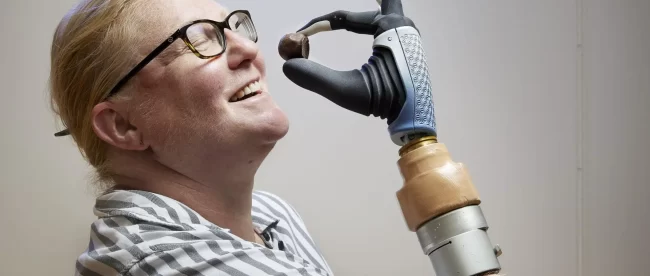
Karin, a Swedish woman who lost her right hand in a farming accident over 20 years ago, faced excruciating phantom limb pain and found traditional prostheses uncomfortable and unreliable. However, a groundbreaking bionic technology emerged, integrating with her remaining limb to provide a more functional and comfortable prosthesis. This innovation significantly reduced her pain and enhanced her daily life.
The human-machine interface, developed by a multidisciplinary team led by Prof. Max Ortiz Catalan, involves connecting the prosthesis to the user’s skeleton via osseointegration and linking it electrically to the nervous system through implanted electrodes in nerves and muscles. This integration allowed Karin to control the bionic hand effectively, decreasing her pain significantly and lessening her reliance on medication.
The technology, part of the DeTOP project funded by the European Commission, combines state-of-the-art prosthetic and robotic technologies, such as the Mia Hand developed by Prensilia, which enabled Karin to perform 80% of daily activities. The success of this highly integrated bionic hand in reducing pain and enhancing functionality at Karin’s level of amputation signifies a major breakthrough in advanced extremity reconstructions, giving hope to those facing limb loss.
The innovative aspect of this bionic technology lies in its fusion with the user’s biological system, offering a more comfortable, reliable, and aesthetically customizable prosthesis. The approach, combining surgical expertise, engineering, and osseointegration, has opened new possibilities for restoring human function in a way never seen before. The collaboration between institutions and their cutting-edge technologies signifies a major step forward in improving the lives of individuals with limb loss.
Interested in learning more? Head over to Science Robotics to read the research paper.