← Back to HEARING
ENGINEERING STUDENTS PARTICIPATE IN EPICS IN IEEE COMPETITION TO DEVELOP INNOVATIVE ACCESSIBILITY SOLUTIONS FOR DISABLED INDIVIDUALS
Engineering Students Participate in EPICS in IEEE Competition to Develop Innovative Accessibility Solutions for Disabled Individuals
September 22, 2024VenkatAccessibility in Education, Awareness, Hearing, Mobility, Motor Skills, Navigation, Seniors, Video Games, Vision, Wheelchair0
In a world where over 1 billion people live with disabilities, the need for innovative accessibility solutions has never been greater. The EPICS in IEEE Access and Abilities Competition, held in 2023, showcased the ingenuity and compassion of engineering students worldwide as they tackled pressing accessibility issues. Let’s dive into some of the groundbreaking projects that emerged from this competition.
Adaptive Gaming Mouse: Leveling the Playing Field
At the University of Florida, a team of 10 biomedical engineering students set out to make gaming more accessible. They developed an adaptive mouse that combines keyboard functions into a single device, allowing individuals with hand or arm abnormalities to game with just one hand. The team’s inspiration came from John McCauley, a junior who recognized the struggles faced by gamers with disabilities.
“Some gamers with arm or hand deficiencies play with their feet, nose, mouth, or elbows, or they use devices not intended for that purpose and are forced to adapt,” McCauley explained. The team’s 3D-printed mouse integrates elements from keyboards, Logitech mice, and Xbox controllers, creating a versatile gaming tool. With their $1,000 grant, they built five devices set to be delivered to recipients through Hands to Love, a Florida-based organization supporting children with upper limb abnormalities.
Side Note: Microsoft recently released various free adaptive 3d printed adaptive thumbstick toppers for disabled gamers.
Campus Accessibility: A Holistic Approach
In Panama, a collaborative team of 15 undergraduate students from the Universidad Tecnológica de Panamá and 24 high school students from Chiriquí took on the challenge of making their campus more accessible. Their multifaceted approach addressed various aspects of campus life:
Braille Signage: Using 3D printing technology, the team created braille signs to improve navigation for visually impaired individuals.
Customized Wheelchair: The students designed and built a personalized wheelchair, tailoring mobility solutions to specific user needs.
Automated Doors: The team automated doors in the engineering department, enhancing access to classrooms and corridors for students with mobility challenges.
High school junior Gael Villarreal emphasized the project’s broader impact: “This project will be very useful, especially [in Panama], where buildings have not been adapted for people with disabilities.” Beyond physical changes, the project fostered valuable soft skills among participants. As another team member, Gianny Rodriguez, noted: “I learned that you need to have new experiences, be sociable, meet and get along with new people, and work as a team to be successful.”
With their $8,100 grant, the team not only implemented these innovations but also invested in community training, ensuring long-term impact and effective utilization of the new accessibility features.
Empowering the Hearing Impaired: Language Learning Kiosk
In Chennai, India, students from the SRM Institute of Science and Technology addressed a critical need for children with hearing impairments. They developed a kiosklike device to help young learners acquire Tamil, the local language. This innovative solution is particularly valuable in rural areas where specialized speech and hearing healthcare is scarce.
The device, resembling an ATM, features surround-sound speakers and touchscreens. It offers tasks and tests focused on auditory awareness, discrimination, and language acquisition. The team worked with 150 pupils aged 5 to 8 at the Dr. MGR Home and Higher Secondary School for the Speech and Hearing Impaired to refine their prototype. With a $1,605 grant, they created a tool that could enhance language learning for hearing-impaired children in the region.
Robotic Walking Aid: Enhancing Senior Mobility
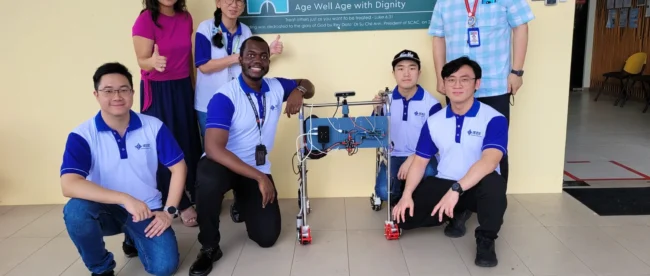
Students from the IEEE Swinburne Sarawak student branch in Malaysia developed an innovative self-navigating walking aid to improve mobility for senior citizens. Building upon a commercial walker, their design incorporates several advanced features:
Wearable Haptic Belt: Detects obstacles and provides tactile alerts to the user.
Intelligent Hand Grips: Pressure sensors detect the user’s intended direction.
Locator Function: Helps users find their misplaced walker.
Autonomous Navigation: Assists users in complex environments.
The team worked closely with residents at Trinity Eldercare to ensure their design met real user needs. As one team member noted, “I gained substantial knowledge in robotics programming and artificial intelligence integration for person tracking and autonomous navigation.” With a $1,900 grant, the students successfully bridged the gap between academic robotics and practical assistive technology. They even presented their prototype at the International Invention, Innovation, Technology Competition and Exhibition in Malaysia, gaining valuable experience in articulating their innovation’s benefits.
The Impact of Innovation Competitions
The EPICS in IEEE Access and Abilities Competition, now in its 15th year, demonstrates the power of engaging students in real-world problem-solving. With 58 proposals submitted and 23 projects funded, the competition involved over 350 students and 149 IEEE volunteers, potentially impacting an estimated 8,000 people in the first year of deployment alone.
These projects not only produce tangible solutions but also foster crucial skills in teamwork, communication, and empathy among participating students. As Gianny Rodriguez, a high school junior involved in the Panama project, reflected, “I learned that you need to have new experiences, be sociable, meet and get along with new people, and work as a team to be successful.”
Conclusion: A Brighter, More Accessible Future
The EPICS in IEEE Access and Abilities Competition showcases the immense potential of young engineers to create meaningful change. By channeling their skills and creativity into assistive technologies, these students are not just solving technical problems – they’re transforming lives.
While the source article doesn’t mention specific plans for further development or funding beyond the initial grants, the impact of these projects is clear. They represent a crucial step towards a more inclusive world, where technology bridges gaps and empowers individuals with disabilities.
As we look to the future, competitions like this serve as a reminder of the importance of nurturing innovation in service of accessibility. They inspire the next generation of engineers to see beyond textbooks and laboratories, encouraging them to engage with real-world challenges and create solutions that make a difference.
By supporting and expanding such initiatives, we can continue to harness the power of technology and human ingenuity to build a world that’s accessible to all. The projects highlighted here are just the beginning – imagine the possibilities as more young minds turn their attention to creating a more inclusive future.