← Back to HEARING
SPELLRING: CORNELL’S WEARABLE AI RING TRANSLATES ASL FINGERSPELLING
SpellRing: Cornell’s Wearable AI Ring Translates ASL Fingerspelling
March 31, 2025VenkatArtificial Intelligence, Hearing0
Key takeaways about the SpellRing project:
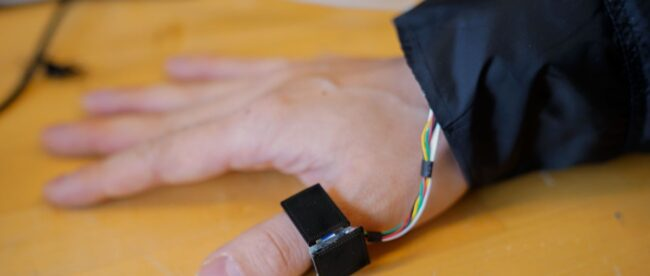
Communication between individuals fluent in American Sign Language (ASL) and those who aren’t can often involve significant delays or misunderstandings. To tackle this, researchers at Cornell University are working on SpellRing, an innovative wearable device. Combining miniature sonar technology (inaudible soundwaves emitted and detected by the ring) with motion tracking (via a gyroscope) and deep-learning AI, SpellRing analyzes hand movements. Worn on the thumb, it’s designed to interpret ASL fingerspelling gestures and display the corresponding letters on a screen in real-time, potentially smoothing conversations where fingerspelling is used.
Building on Past Efforts and Focusing on Practicality
SpellRing isn’t the first attempt at technological ASL interpretation; the Cornell SciFi Lab has previously explored tools for gestures and even silent speech. However, many earlier technological concepts for recognizing ASL haven’t been widely adopted by the Deaf and hard-of-hearing community, often because the equipment was too bulky or impractical for everyday use. The SpellRing team specifically aimed for a compact, single-ring design to capture complex finger movements unobtrusively. This focus on a user-friendly form factor represents an effort to learn from past attempts and create something potentially more viable for daily interaction.
SpellRing, Deaf Culture, and the Path Ahead
For the Deaf community, tools like SpellRing could potentially ease interactions with hearing individuals who lack ASL fluency, specifically during moments requiring fingerspelling (like spelling names or specific English words). However, it’s crucial to understand that ASL is a rich, complete language involving far more than just fingerspelling – it incorporates specific handshapes, movements, facial expressions, and body posture. SpellRing, in its current form, only addresses a small fraction of this linguistic system. While the researchers have involved ASL signers in training and aim to bridge the gap between developers and the user community, acceptance will likely depend on future advancements. The Deaf community values ASL in its entirety, and while helpful for specific situations, a fingerspelling-only tool doesn’t replace language fluency. The designers acknowledge this limitation is just a first step, with plans to potentially expand the technology (perhaps using eyeglass-mounted systems) to recognize facial and upper-body cues, moving closer to understanding the full scope of ASL.